

What's on this page
- Before you start: what you need
- Step 1: Understand what actually builds a credit score
- Step 2: Open the right first card
- Step 3: Become an authorized user
- Step 4: Use it tiny and pay it in full every month
- Step 5: Add rent reporting and a credit-builder loan
- Step 6: Monitor your score and avoid the traps
- A worked example: a student from no credit to a first score
- Common mistakes students make
- Troubleshooting: no income, no cosigner, thin file
- Graduating a secured card and reclaiming your deposit
- What happens to your credit when you leave school
- When an authorized-user account works against you
- Reading your first statement without alarm
- Timing your start to the fall semester
- An on-campus budget that keeps your credit safe
- Your student credit-building checklist
- The bottom line
Short answer: Build credit as a student in six steps: learn what a score is made of, open one reporting account such as a secured card or become an authorized user on a parent's account, put a tiny recurring charge on it, pay in full and on time every month, add extra reporting later, and watch your progress. Illustratively, a first score appears after about six months and a good one after twelve to eighteen.
Starting a new school year is one of the rare moments when it actually pays to do something boring on purpose. While your credit file sits empty, every month is a month you are not yet building the record that decides whether you get an apartment lease, a car loan, or a fair rate on either. The good news is that building credit as a student is not complicated, and it does not require money you do not have. It requires one reporting account, a tiny amount of spending, and the discipline to pay it off every month, held steady while the calendar does the rest.
This playbook lays out that path as six clear steps, from understanding what a score is actually made of to opening the right first card, borrowing a head start as an authorized user, using the card correctly, layering in extra reporting, and watching your progress without tripping the common traps. For the wider view of building credit at any age, see our from-scratch credit playbook, and to price any future borrowing you can run the numbers in the debt payoff calculator. The short version, if you want it now: open one small line, spend a little, pay it in full on time, and repeat.
Key takeaways
- You can build credit as a student with no income by using a secured card or becoming an authorized user on a parent's seasoned account.
- The whole strategy is one reporting account, a tiny recurring charge, and paying the statement in full and on time, every single month.
- Payment history and utilization together drive most of your score, and both are things a brand-new borrower controls from month one.
- An illustrative timeline runs about six months to a first score and roughly twelve to eighteen months to a good one, assuming clean payments.
- The biggest myth to drop is that carrying a balance helps: it only costs interest, and paying in full builds credit just as fast for free.
Before you start: what you need
Building credit as a student takes less than most people expect, but it does take a few things in place before you apply for anything. Gather these first so your first application is not a wasted hard inquiry on a card you cannot get.
- Identity and eligibility. You generally need a Social Security number, or in some cases an Individual Taxpayer Identification Number, to open a reporting account. Applicants under 21 in the United States usually need to show income or add a cosigner or joint applicant.
- A small income or an authorized-user option. Part-time pay, work-study, allowances, scholarship refunds, and grants can often count as income on a student card application. If you have none of these, a parent adding you as an authorized user, or a secured card backed by a deposit, sidesteps the income question entirely.
- A bank account. A checking account lets you set up autopay, which is the single most important tool you will use, and it is what a secured card's deposit is usually funded from.
- A little cash, or not. A secured card needs a refundable deposit, often a couple hundred dollars. A student card and an authorized-user slot need no deposit at all.
Time to set up: about an afternoon to apply and fund an account. Time to a first score: roughly six months of on-time reporting. Difficulty: genuinely easy, because the hard part is patience, not skill. With those pieces in hand, the six steps below take you from an empty file to a real, growing score. You can run your own starting point through the companion beside this article as you go.
Step 1: Understand what actually builds a credit score
Before you open anything, spend five minutes learning where a score comes from, because it turns every later step from a rule you follow into a decision you understand. A credit score is not a mysterious judgment; it is arithmetic over a handful of known factors. The major models weigh five things, and while the exact percentages shift by model and person, the commonly cited shape is stable enough to build a plan around.
What makes up a credit score (%)
Illustrative, commonly cited weights of the five factors. Widths are drawn from each value against the largest, payment history.
These shares are illustrative and commonly cited rather than exact for any one model. The lesson is the ranking: payment history and utilization together make up the large majority of the score, so a student who masters those two is most of the way there.
Read that chart as a to-do list in disguise. The two tallest bars, payment history and utilization, account for roughly two-thirds of the score between them, and they are precisely the two factors a student with a brand-new file can control from the very first month. Pay on time, keep your balance low, and you are directly serving the majority of the score before you have any history at all. The other three factors, age, mix, and inquiries, matter too, but they lean on time more than effort, which is why starting now beats starting later. Our note on how credit utilization works unpacks the second bar in detail. Watch out for one trap here: do not chase the smaller factors, like credit mix, by taking on debt you do not need. History first, utilization close behind, everything else after.
Step 2: Open the right first card
With the factors clear, open one reporting account, and for most students that means picking between a student credit card and a secured card. A student card is an unsecured card built for enrolled students with thin files; it needs no deposit, tends to carry a low limit and small or no annual fee, and sometimes adds minor perks. A secured card asks for a refundable deposit, often somewhere between two and three hundred dollars, which usually becomes your credit limit. That deposit is collateral, not a fee, and you get it back when you graduate the card or close it in good standing.
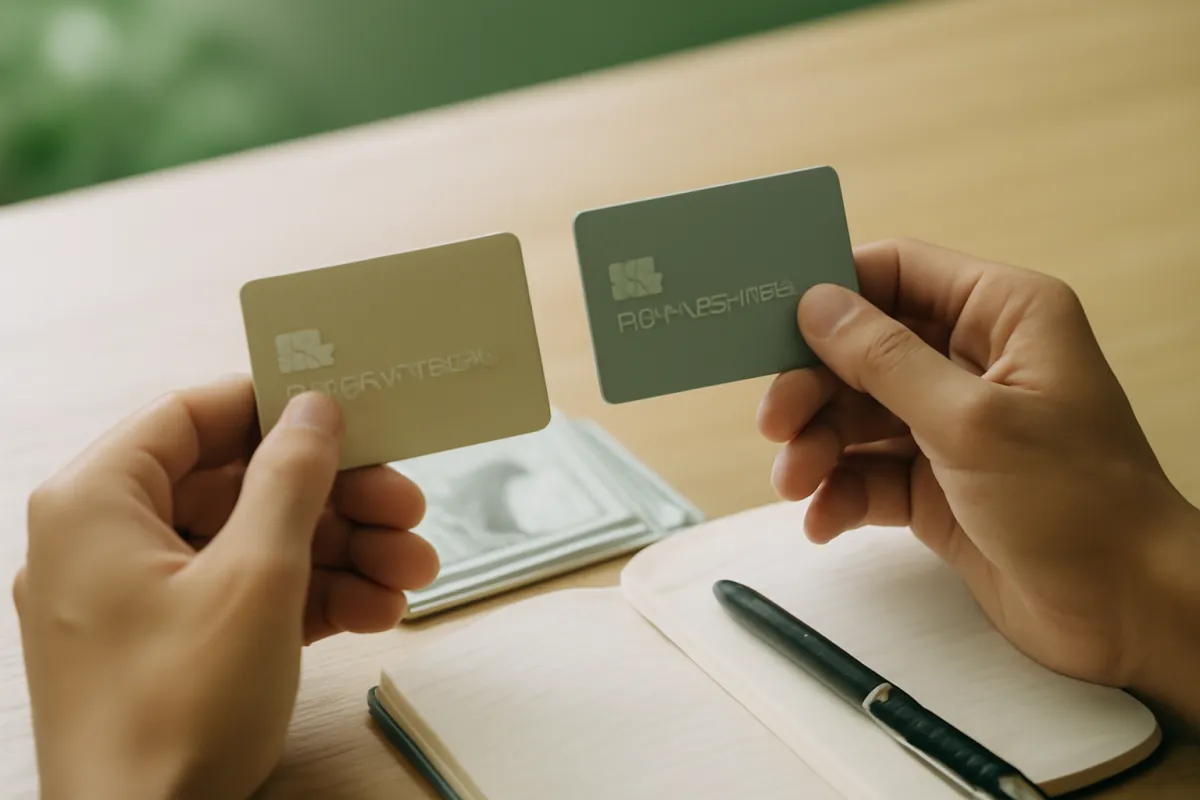
Here is the practical decision. If you have any income to report, apply for a no-fee student card first, because it keeps your cash in your pocket. If you have no income, a truly blank file, or you get declined, fall back to a secured card, whose deposit all but guarantees approval and which builds credit identically. Whichever you choose, favor a card that reports to all three major bureaus and, for a secured card, one with a clear path to graduate to an unsecured version so you eventually get your deposit back. Our full note on secured credit cards walks the deposit mechanics, the reporting, and the graduation path in detail, and our playbook on the authorized user credit card covers the faster route if a family member is willing to add you to an old account. Watch out for the temptation to apply to several cards to see what sticks; each application is a hard inquiry on a file that can least afford them, so pick one, apply once, and move on. Run your limit and spending through the companion to see the utilization your choice will report.
Step 3: Become an authorized user
The one step that can hand you history you did not personally earn is becoming an authorized user, and for a student it is often the single fastest accelerator available. Someone with an established, well-managed credit card, usually a parent or close family member, adds you to their account. You may or may not ever hold or use the physical card; the point is that on many cards the account’s full history then reports on your own credit file. If that account is years old, has never missed a payment, and carries a low balance, you can inherit a slice of that strong record and see a score appear far sooner than you could build one alone.
Doing it well takes two checks. First, confirm the issuer actually reports authorized users to the bureaus, because not all do, and an account that does not report gives you nothing. Second, be sure the primary cardholder handles the account cleanly, because the reporting runs both ways: if they run the balance up or miss a payment, that damage can land on your file too. That is why this only works with someone whose habits you trust completely. Treat authorized-user status as a jump-start, not a finish line. It can seed your file with age and payment history from close to day one, but lenders ultimately want to see credit you manage in your own name, so pair it with the card from Step 2. Watch out for one detail: ask the primary holder to keep that card’s balance low, since its utilization can flow onto your report as well.
Step 4: Use it tiny and pay it in full every month
This is the step that actually builds the score, and it is deliberately small. Once your card is open, put one modest recurring charge on it and nothing else. A streaming subscription, a phone bill, or a weekly coffee is plenty. The goal is not to spend; it is to generate a small, steady stream of on-time payments while keeping the reported balance low. Then set autopay to clear the full statement balance automatically, so an on-time payment is guaranteed even in a busy exam week, and you never pay a cent of interest.

The math is where students most often go wrong, so make it concrete. On a card with a $500 limit, letting a $300 balance report puts your utilization at 60 percent, which reads as strained even if you pay it off days later, because the bureaus photograph whatever balance is showing when the statement cuts. Keep that reported balance near $25, and your utilization sits around 5 percent, exactly where strong profiles live. Because student limits are small, even ordinary spending can spike the ratio, so either keep the charge tiny or pay the card down before the statement date. Our note on how credit utilization works covers that timing in full. Watch out for the balance-carrying myth: paying in full builds your history just as well as carrying a balance, and it does so for free. Run your own spend and limit through the companion to see the exact utilization you would report.
Step 5: Add rent reporting and a credit-builder loan
Once your card is humming along, you can thicken a thin student file by getting credit for money you already spend and by adding a second type of account. A growing number of services will report your on-time rent, and sometimes certain utility, phone, or streaming payments, to one or more of the major bureaus. Because you are paying rent and bills anyway, this layers positive data onto a sparse file with no new borrowing and no risk. It is a natural fit for a student in an off-campus apartment, and it works best stacked on top of the card, not in place of it.
The second addition is a credit-builder loan, which builds the installment side of your file that a card cannot reach. The lender deposits a small loan amount, often a few hundred dollars, into a locked savings account you cannot touch, and you make fixed monthly payments that report as on-time. When you finish, the savings are released to you, so in effect you are paying yourself while building an installment record and rounding out your credit mix. Keep the payment small enough to cover comfortably on a student budget. Watch out for two things: not every rent service reports to all three bureaus or counts equally in every model, so the boost can be uneven, and some charge a monthly fee, so weigh the cost against the likely benefit. Treat both tools as supplements to the core habit from Step 4, useful for adding data points while the card does the heavy lifting.
Step 6: Monitor your score and avoid the traps
The final step is to close the loop by watching your progress, because a feedback signal keeps you on plan and catches problems early. Checking your own score is a soft pull, which never affects your score no matter how often you look, so there is no reason to fly blind. Many card apps, banks, and free standalone services now show a score and let you track it month to month, and you are entitled to free copies of your actual credit reports, where you can confirm your accounts are reporting correctly and watch for errors that could quietly hold you back.

Use the view to hold your discipline rather than to worry. Confirm your first account is reporting, watch your score appear once you cross the roughly six-month mark, and check that no balance is reporting higher than you expect. The traps to avoid are the familiar ones for a thin file: never miss a payment, since that does outsized damage; never let a small limit get maxed out; and never apply for a cluster of cards at once, which piles up hard inquiries and drags down your brand-new average account age. Keep your oldest card open even after you graduate to better products, because closing it later would shorten your history. Watch out for the impatience trap most of all: the urge to build fast by grabbing more credit is the very thing that slows a student down. Boring and steady wins here.
A worked example: a student from no credit to a first score
Make it concrete with one person. Say Maya is a nineteen-year-old sophomore with a completely blank credit file, a part-time campus job paying a small amount, and no savings to spare. In month one she applies for a no-fee student card using her work-study income, is approved with a $500 limit, and at the same time her mother, who has a twelve-year-old card she always pays on time, adds her as an authorized user. Maya sets autopay on her own card to clear the full statement, and she puts only her $11 music subscription on it, so her reported balance hovers near 2 percent of her limit.
A student's first year of credit building
Illustrative split of where a clean first year's progress comes from, summing to 100.
Shares are illustrative, chosen to show the shape of a student's first year rather than exact model weights. The lesson is that most of the early gains come from the two things you directly control, on-time payments and low balances, while age and mix build in the background.
By month two, her mother’s long, clean history is reflecting on Maya’s file, and because of that seasoned account the models can already generate an early score. By month six, her own student card has half a year of perfect payments and low utilization reporting, so her score now rests on data that is genuinely hers. Around this point she signs up for a rent-reporting service on her new off-campus apartment and adds a small credit-builder loan, giving her file an installment account beside the revolving card. She resists opening three more cards for the sign-up perks, keeping just the two accounts and letting them age. Somewhere between months twelve and eighteen, with a spotless record, single-digit utilization, a lengthening history, and a healthy mix, Maya crosses into good-credit territory. Nothing she did was clever. She opened one line, automated it, kept the balance tiny, borrowed a head start, and waited. You can run your own version of Maya’s path in the companion beside this article and price any future loan in the debt payoff calculator.
Common mistakes students make
Building credit is mostly doing a few simple things consistently, but a handful of avoidable mistakes catch students most often and can undo months of progress. Watch for these.
- Carrying a balance thinking it helps. This is the most common myth. Leaving a balance unpaid does nothing extra for your score; it only costs you interest. Paying the statement in full builds your history just as well and for free.
- Maxing out a small limit. On a $500 card it is easy to run utilization high without noticing. Because utilization is the second-biggest factor, a high reported balance drags your score down even when you pay it off later. Keep the reported balance in the single digits of your limit.
- Missing a payment. Payment history is the largest factor, and a thin file has little positive record to cushion a late mark. One missed payment can linger for years. Automate at least the minimum so it can never happen by accident.
- Applying for too many cards at once. Each application is a hard inquiry and lowers your average account age. A burst of them looks like distress and slows you down. Space applications out by many months.
- Closing the first card. Your oldest account anchors your credit age. Closing it later shortens your history and can nudge your score down, so keep that first no-fee card open for the long haul.
The thread through all five is impatience. Our note on how many credit cards you should have covers the card-count question in depth, but the short version for a student is that one line handled cleanly beats several handled carelessly.
Troubleshooting: no income, no cosigner, thin file
Real student situations rarely fit the tidy version, so here is how to handle the common snags.
What if you have no income at all? A secured card is your most dependable route, because the refundable deposit stands in for an income check and approval is nearly automatic. Failing that, an authorized-user slot on a parent’s card needs no income from you whatsoever, and it can seed your file with history while you wait for a job.
What if you have no cosigner and no family member who can add you? Lean fully on the secured card. It asks nothing of anyone but you and a small deposit, reports exactly like any other card, and graduates to unsecured once you have shown a stretch of clean payments. Layer rent reporting on top to add data faster.
What if you are an international student? Many students unlock cards once they obtain a Social Security number through authorized work, and some issuers accept an ITIN instead. A secured card tied to a US bank account is often the surest starting point, and a few newer programs build credit for newcomers using bank or enrollment data rather than a domestic file. Start early in your program, since the score still needs about six months to appear.
What if your file is thin and the score just will not show up? Patience is usually the answer, because the models need roughly six months of reporting before they can score you at all. If it has been longer, check that your account is actually reporting to the bureaus, and consider adding a second reporting item, such as rent or a credit-builder loan, to give the models more to work with. Our note on how long it takes to build credit maps the full timeline.
Graduating a secured card and reclaiming your deposit
The secured card is a starter, not a destination, and the moment worth planning for is graduation: the point where the issuer converts your secured account into a regular unsecured card and returns the deposit you put down. On many cards this happens on its own after a stretch of on-time payments, often somewhere around six months to a year, when the issuer reviews the account and decides your record no longer needs collateral behind it. On others you have to ask, and a polite call once you have a clean run of payments is worth making.
Graduating in place is the outcome to aim for, because it hands you back your deposit while keeping the same account, and therefore the same age, alive on your file. That preserved history matters: opening a brand-new card and closing the secured one would reset the clock on your oldest account, exactly the mistake Step 6 warns against. If the issuer will not graduate the card, the cleaner move is usually to keep it open and idle while you qualify for a better card elsewhere, then close the secured one only if its fee makes holding it pointless. Watch out for one detail: closing a secured card refunds the deposit, but it also removes that credit line, which can nudge your utilization up if it was carrying much of your total limit. Confirm the graduation terms in your cardholder agreement, since they vary by issuer, and time any close for after a stronger account is doing the work.
What happens to your credit when you leave school
Graduation from the institution, not the card, brings its own set of small transitions, and knowing them ahead keeps a good four-year record from stumbling at the finish. A student credit card does not vanish when you stop being a student; most issuers simply keep the account open, and some quietly convert it to a comparable non-student card, so the history you built rolls forward intact. That continuity is the reward for keeping the account open, which is why the checklist treats your first card as a long-term hold rather than a phase.
Two changes deserve attention as you leave. First, your student loans, if you have them, typically enter repayment after a grace period of several months, and those payments start reporting as an installment record, for better or worse depending on whether they land on time. Second, an address change, a new job, and a possible move onto your own accounts can all shift the details lenders see, so update your contact information and keep autopay funded through the transition. Watch out for the temptation to celebrate a first salary by opening several new cards at once; a burst of applications right as your file matures dents the average account age you spent years growing. The steadier play is to let the student card age into your anchor account, add new credit slowly and only when you have a reason, and carry the same pay-in-full habit from campus into your first real budget. The mechanics that built the score do not change once you graduate; only the size of the numbers does.
When an authorized-user account works against you
Step 3 treats the authorized-user slot as an accelerator, and usually it is, but the arrangement can reverse on you, and a student should know the exit before needing it. Because the primary cardholder’s behavior reports to your file, a card that suddenly runs a high balance or misses a payment can drag your young score down as fast as it once lifted it. A thin file has little cushion, so a single bad month on a borrowed account can undo visible progress, which is the risk baked into inheriting someone else’s history.
The remedy is simpler than the worry. If the account you were added to starts sliding, ask the primary holder to remove you as an authorized user; issuers can usually do this quickly, and once you are off the account, most models stop factoring its history into your file going forward. That is why the arrangement only belongs with someone whose habits you trust and whose account you can watch, at least loosely, through a shared view or an honest conversation. Watch out for two quieter versions of the problem: an authorized-user account that the issuer never reported in the first place, which simply gives you nothing rather than harm, and one that gets closed by the primary holder, which can remove that age from your file and leave a gap. Neither is a catastrophe if your own card from Step 2 is already reporting, which is the deeper reason to build credit in your own name alongside any head start. Lean on the borrowed history, but never let it be the only thing holding your score up.
Reading your first statement without alarm
The first credit card statement unsettles a lot of new borrowers, because it arrives full of numbers that look more alarming than they are. The line that matters most is the statement balance, the amount you owed when the cycle closed, and on a card you are using for one tiny recurring charge it should be small and unsurprising. Pay that figure in full, or let autopay clear it, and the interest column stays at zero, no matter what other numbers share the page.
A few entries tend to cause needless panic. The credit limit is not a target or a suggestion; it is a ceiling, and the whole utilization strategy from Step 4 is about staying far below it. The minimum payment prints in bold as though it were the expected amount, but on a student file paying only that keeps a balance alive and costs interest, so treat it as a floor rather than an instruction, the same lesson our note on how much to pay on a credit card works through in detail. The available credit simply reflects your limit minus the current balance and refills as you pay. Watch out for the statement closing date specifically, because that is the day your balance is photographed for the bureaus, so a charge cleared a day after it still reports; paying a little before the close date keeps the reported number low. Read the statement once with these labels in mind and it stops being a source of dread and becomes what it is: a monthly scorecard of a habit you already have under control.
Timing your start to the fall semester
If you are reading this in August or September, you are standing at the best natural starting line the student calendar offers. The weeks around move-in are when the practical pieces of this playbook assemble themselves anyway: you are opening or updating a bank account, sorting out how rent and bills get paid, setting up a phone plan, and sitting down with family before the semester scatters everyone. Each of those chores pairs with a step above. The bank account enables autopay from Step 4, the rent arrangement is the raw material for the rent reporting in Step 5, the phone bill is a perfect tiny recurring charge, and the family conversation is the natural moment to ask about the authorized-user slot in Step 3, face to face instead of over a rushed call in October.
The calendar math also favors a fall start. An account opened as classes begin has its roughly six months of reporting done by the spring semester, which means a first score can exist before summer sublets, internship relocations, and next year’s apartment hunt start asking for one. Start in the spring instead and that same first score lands mid-summer, after the leases are signed. Nothing about credit scoring cares what month it is; the advantage is entirely that landlords and lenders tend to show up in a student’s life on a school-year rhythm, and a fall start gets the file ready before they knock.
One caution keeps the timing honest. The start of a semester is also when campuses see the heaviest marketing for cards, apps, and financial products aimed at students, and a table with free merchandise is not a vetting process. The plan does not change because the pitch arrived first: one card, chosen by the criteria in Step 2, opened once. If a September table offer happens to match what you would have picked anyway, fine; if not, walking past it costs you nothing but the free water bottle.
An on-campus budget that keeps your credit safe
The quiet partner behind every step in this playbook is a budget that actually works on a student’s income, because the card habit only stays boring when the rest of the month is under control. The version that fits campus life is deliberately simple. Add up what reliably comes in each month: work-study or part-time pay, family support, the slice of any scholarship or aid refund you assign to living costs. List the fixed bills that leave first: rent if you live off campus, the phone, the meal plan or groceries, the streaming subscription riding on your card from Step 4. What remains is the flexible pool for everything else, and the single rule that protects your credit is that the card never spends money the pool does not have.
Run that rule through the mechanics you already know. Your card charge is small and recurring, so it is a fixed bill, funded before the flexible spending starts, which is what makes the autopay in Step 4 safe instead of hopeful. An aid refund that arrives as a lump sum gets divided by the months it must cover before any of it is spent, because a flush September that becomes a broke November is exactly the month a payment gets missed. And the buffer matters more than the spreadsheet: even twenty or thirty dollars left unassigned each month is the difference between a surprise textbook fee and a balance you cannot clear in full.
The payoff shows up in the numbers the bureaus see. A budget with the card charge funded first produces the same clean pattern every cycle, a small reported balance and a paid-in-full statement, which is the entire engine of this playbook running on autopilot. If the month does go sideways, pay the card down before the statement cuts so the reported balance stays small, and fall back on the priorities in our note on how much to pay on a credit card: the full balance when you can, more than the minimum always. A student budget does not need to be impressive. It needs to make the on-time payment inevitable.
Your student credit-building checklist
Save this and work down it over your first year.
- Confirm your eligibility: Social Security number or ITIN, and income or an authorized-user or secured-card path if you are under 21.
- Open a checking account and be ready to set up autopay.
- Apply for one card: a no-fee student card if you have income, a secured card if you do not or get declined. Apply once, not to several.
- Ask a trusted family member to add you as an authorized user on an old, clean, low-balance card, and confirm the issuer reports authorized users.
- Put one tiny recurring charge on the card and set autopay to clear the full statement balance every month.
- Keep the reported balance in the single digits of your limit; pay it down before the statement cuts if needed.
- Add rent reporting and a small credit-builder loan once the card is running smoothly.
- Check your score monthly as a soft pull, and read your free credit reports for errors.
- Never miss a payment, never max the card, and keep your first card open for the long term.
- Give it about six months for a first score and roughly twelve to eighteen for a good one.
The bottom line
Building credit as a student is not a trick to discover; it is a short list of boring habits started early and held steady. Open one reporting account, a student card if you have income or a secured card if you do not, and borrow a head start by becoming an authorized user on a trusted family member’s seasoned card. Then run the whole thing on autopilot: one tiny recurring charge, autopay set to clear the full statement, and a reported balance kept low so your utilization stays where strong profiles sit. Those two factors, payment history and utilization, make up most of your score and are the ones you control from day one. Layer in rent reporting and a credit-builder loan to thicken a thin file, watch your progress with free soft-pull checks, and resist the impatient urge to grab more credit than you can manage. Give it about six months for a first score and roughly a year more for a good one, keep that first card open, and you will leave school with the one asset that quietly makes everything after it cheaper.
A closing word on how to read this playbook: BorrowLane writes to explain how student credit building commonly works, not to hand you a personalized financial plan, so treat everything here as general education rather than credit, financial, or legal advice for your own situation. Every timeline, limit, deposit, and percentage above, including Maya’s twelve-to-eighteen-month path and the $500 student card, is an illustrative figure chosen to show the mechanics, and your real results will hinge on your full credit file, the specific products you use, each issuer’s reporting choices, your age and residency, and the scoring model a given lender applies, none of which one article can see. Eligibility rules, issuer terms, and scoring models also change over time. Before you open a student or secured card, become an authorized user, sign up for rent reporting, or take on a credit-builder loan, read the product’s own terms, check your own credit reports, and consider talking it through with a qualified financial professional or your school’s financial-aid office.
Frequently asked questions
Can a student with no income get a credit card?
Often yes, though it depends on the card and your age. Since 2010, applicants under 21 in the United States generally need to show independent income or add a cosigner or an adult who accepts joint responsibility, but many student cards count allowances, grants, scholarship refunds, and part-time or work-study earnings as income. If none of those apply, the two reliable paths are a secured card, where a refundable deposit stands in for an income check, or becoming an authorized user on a parent's card. In illustrative terms, a student who lands even one reporting account and pays it on time can see a first score emerge in roughly six months, income or not.
What is the best type of first credit card for a student?
For most students the choice comes down to a student card versus a secured card, and the right pick depends on whether you can get approved. A student credit card requires no deposit and sometimes adds small perks, but approval is not guaranteed on a truly blank file or with no income. A secured card asks for a refundable deposit, often a couple hundred dollars, which becomes your limit and all but guarantees approval. Both report to the bureaus the same way, so both build credit equally well. A common approach is to try for a student card first and fall back to a secured card if you are declined.
How long does it take a student to build credit?
You generally need at least one account reporting for about six months before the main scoring models can generate a score at all. From that first number, reaching what lenders call good credit usually takes another year or so of clean payments and low balances, so a rough illustrative window is twelve to eighteen months from your very first account. The timeline can start earlier if you are added as an authorized user on a parent's seasoned card, because that history can report to your file from close to the day you are added. Our note on how long it takes to build credit walks through the milestones in detail.
Should a student become an authorized user or open their own card?
The strongest starts often do both at once, because they build different things. Becoming an authorized user on a parent's old, well-managed card can put age and payment history on your file almost immediately, which is a head start you cannot create on your own as a newcomer. A card in your own name, whether a student card or a secured card, builds credit that is unambiguously yours, which lenders ultimately want to see. If you have to choose, an authorized-user slot is the faster jump-start, but plan to add a card of your own within a few months so your file stands on its own.
Do student credit cards build credit as well as regular cards?
Yes. From the bureaus' point of view a student card is simply a credit card: it reports your payment history and your utilization every month exactly like any other unsecured card. The student label mostly affects who can get approved and which small perks come attached, not how the account builds your score. That means the habits matter far more than the card's name. A student card paid on time and kept well below its limit builds credit just as effectively as a premium card used the same way, and the low limits typical of student cards make disciplined utilization the main thing to watch.
Can international students build credit in the United States?
Usually yes, though the on-ramp takes an extra step or two. Many international students can get a Social Security number through on-campus or authorized work, which unlocks most secured and student cards. Without an SSN, some issuers accept an Individual Taxpayer Identification Number, and a handful of newer programs build credit for international students using bank history or school enrollment instead of a domestic file. A secured card tied to a US bank account is often the most dependable starting point. As with any newcomer, the score itself still needs about six months of on-time reporting before it appears, so starting early in your program helps.
Does paying student loans build credit?
Yes, once they are in repayment and reporting, and even sometimes before. Federal and private student loans are installment accounts, so each on-time payment adds to your payment history and the loan itself adds installment variety to your credit mix. Loans in deferment while you are enrolled may still appear on your report as open accounts, which can help your file look established, though they are not building an active payment streak until payments begin. The catch is the mirror image: a missed student-loan payment damages your credit the same way any late payment does, so treat those bills with the same on-time discipline as a card.
What is the biggest credit mistake students make?
Carrying a balance on purpose is the most common and costly myth, closely followed by missing a payment. Many students believe leaving a balance unpaid helps their score, when in truth it only costs interest while doing nothing extra for your credit; paying in full builds history just as well and free of charge. Missing a payment is worse, because payment history is the largest scoring factor and a thin student file has little positive record to absorb the hit. Add maxing out a small limit and applying for several cards at once, and you have the short list of avoidable errors that slow a student's progress most.

Hamza Hai is the editor of BorrowLane. She holds an MBA and reviews the site's articles against our editorial standards, checking that every figure is labelled for what it is, that nothing is presented as verified fact without a source the reader can check, and that the writing stays useful to a non-specialist.