

What's on this page
- Why does my credit score keep going down?
- Which reason is yours? Start with when the drop showed up
- How credit scores actually move month to month
- Reason 1: a new application landed a hard inquiry
- Reason 2: a new account reset your average account age
- Reason 3: your reported credit utilization went up
- Reason 4: an issuer cut your credit limit
- Reason 5: a payment reached 30 days late
- Reason 6: a collection or charge-off appeared
- Reason 7: an account closed, was paid off, or aged off
- Reason 8: an error or a fraudulent account is on the file
- Reason 9: the number you looked at changed, not your file
- Why did my credit score drop when nothing changed?
- Why does my credit score go up and down every month?
- Why is my credit score so low when I have never missed a payment?
- Why is my credit score not improving?
- The stuck-score checklist: what to change first
- Why is my credit score different on different sites?
- Bureaus, models, and dates: the three sources of score gaps
- Which credit score is the real one?
- How to find out exactly what dropped your score
- How to turn a falling score around
- When a score drop matters, and when to let it pass
- A worked example: one statement date, one avoidable drop
- The bottom line
Few money moments are more deflating than opening a banking app and watching the credit score tick down in a month when you did everything right. Every bill was paid. Nothing new was opened. The number fell anyway, or refuses to rise, or reads noticeably differently on two apps checked on the same morning. The uncomfortable truth is that a credit score is not a grade for good behavior. It is a fresh calculation run on a file that changes constantly, on dates you do not control, by formulas you never see.
This playbook turns that frustration into a diagnosis you can finish in one sitting. It opens with the direct answer, then sorts the nine real causes of a falling score by how fast each one reaches your file, because when the drop appeared is the single most useful clue about what caused it. From there it takes the two sibling questions that always arrive alongside: why a score gets stuck and stops improving even with perfect payments, and why the same person sees different numbers on different sites. Our notes on how credit utilization works and how to raise your credit score pick up where the diagnosis ends.
Key takeaways
- Almost every drop traces to nine causes: a hard inquiry, a new account, higher reported balances, a limit cut, a late payment, a collection or charge-off, an account closing or aging off, a reporting error, or a change in which score you are looking at.
- Timing narrows the field fast. Each cause has a typical lag between the event and the day it can move a score, from a few days for an inquiry to roughly half a year for a collection.
- A score can fall when "nothing changed" because the file changed anyway: balances report on statement dates, limits move without your involvement, and old accounts age off on a schedule set years ago.
- Stuck scores are usually capped by statement-day balances or by a young file, not by a lack of effort. On-time payments hold the floor rather than raise the ceiling.
- No point figures appear in this playbook, because the same event moves different files by wildly different amounts and quoting a number would be inventing precision. Causes and timing are knowable; the exact size of your drop is not.
Why does my credit score keep going down?
A credit score goes down because something in the file underneath it changed, and only nine changes do most of the damage. A new application put a hard inquiry on the report. A new account pulled your average account age down. Your reported balances rose against your limits. An issuer cut a credit limit. A payment was reported 30 or more days late. A collection or a charge-off landed. An account closed, was paid off, or aged off the report. An error or a fraudulent account appeared. Or nothing in your file moved at all and the app you check simply switched which model or bureau it shows you. Nearly every drop that feels like it came from nowhere is one of those nine.
The word keep matters, because a score that falls repeatedly usually has one recurring mechanism behind it rather than nine separate misfortunes. The most common by a distance is the balance cycle: each card reports its statement balance once a month, so a heavy month reports high and pulls the score down, and a lighter month reports low and lifts it back. The second most common is a run of applications, each one landing an inquiry and a brand new account at the same time. If your score has drifted down three months running, hunt for the pattern that repeats monthly before you hunt for a disaster.
What never helps is guessing from the number itself. The score is a summary; the report is the evidence, and the evidence is free. Everything below assumes you will open your actual reports at some point in the process, because a cause you can see on paper is a cause you can act on, and a cause you have inferred from a falling gauge is just anxiety with a decimal point.
Which reason is yours? Start with when the drop showed up
The fastest way to narrow nine causes to one is not to ask what you did, but when the number moved. Every cause has a characteristic lag between the triggering event and the day it can reach a scoring model, and those lags are far apart enough to be diagnostic. An inquiry lands within days. A balance waits for a statement to close. A late payment cannot appear until it is at least 30 days old, and then waits for the next reporting cycle. A collection typically arrives half a year after the trouble started. Line the drop up against the calendar and most files answer their own question.
How long each trigger takes to reach your file
Illustrative lag between the event and the earliest day it can move a score. Reporting cycles differ by lender, so read these as shape, not schedule.
Bars are scaled against the longest lag shown, roughly 180 days. Two causes sit on no bar at all because they have no lag: a reporting error can surface any time, and a change in which model or bureau your app displays moves the number without touching your file.
Read the chart as a lookup table. If the score moved within a week of applying for anything, start at reason 1 and 2. If it moved with no event you can name, and the timing lines up with a statement closing date, start at reason 3, then check limits for reason 4. If it moved about two months after a chaotic month, reason 5 is the first place to look. If it fell steeply with no recent trigger, count back roughly half a year and ask what bill was left behind then, because that is the window in which collections and charge-offs surface. And if the timing matches nothing whatsoever, you are probably looking at reason 8 or reason 9.
Size gives a second, cruder clue, and it is worth saying plainly why this playbook attaches no point figures to any of it. The same event moves different files by very different amounts, because scoring models react to the shape of the whole file rather than to events in isolation, and a mark that barely dents a thin young file can be severe on a long spotless one. Any specific number would be invented precision. What holds across files is the ranking: payment-history events are the heaviest, balance events are the middleweight and the fastest to reverse, and inquiries and aging effects are the lightest. Use the ranking, ignore anyone quoting you an exact figure for a file they have never seen.

How credit scores actually move month to month
Before the causes, a mental model that dissolves half the confusion on its own. A credit score is calculated fresh every time somebody asks for it, from whatever your bureau file says at that moment. There is no running total that gets adjusted up or down. There is only a formula applied to a snapshot. When the snapshot changes, the number changes. That is why a score can move without any event you would recognize as news: one balance reporting higher on one card is a change to the snapshot, even though nothing about your life changed.
The widely cited scoring recipe weighs the file in five buckets, and the proportions below are the commonly published illustrative breakdown rather than a secret anyone has decoded.
What a credit score weighs, commonly cited breakdown
Illustrative factor weights in the most widely referenced scoring recipe. Exact weights vary by model and by file.
Two buckets, payment history and amounts owed, carry roughly two thirds of the weight. Nearly every meaningful score drop lives in one of those two.
Notice what the two charts imply together. The timing chart tells you where to look first; this one tells you how hard the finding is likely to hit. Payment history and amounts owed carry about 65% of the weight between them, so a sharp move almost always sits in one of those two, meaning something reported late or balances reported high. The remaining three buckets, age, new credit, and mix, produce the smaller drifts that show up after you open a card or a loan quietly matures. Keep both maps in mind through the nine causes below, which run from the fastest-arriving to the slowest.
Reason 1: a new application landed a hard inquiry
This is the quickest cause to reach a file, which is why it heads the list. Apply for anything that involves a credit decision, and the lender pulls your report; that pull is recorded as a hard inquiry, often within a couple of days. A single inquiry is one of the mildest negatives a report can carry and it fades in importance over months, so one application on its own rarely explains a serious drop. What moves scores is the pattern. Several inquiries inside a short window reads to a model like somebody reaching for credit, and the new-credit bucket responds accordingly.
Two clarifications keep this factor in proportion. First, checking your own score is a soft inquiry and costs nothing, ever; only applications create hard pulls, a distinction our note on hard inquiries versus soft unpacks in full. Second, the major scoring models treat multiple inquiries for the same loan type inside a shopping window, commonly cited as somewhere between two weeks and about six weeks depending on the model, as a single event, precisely so that comparing lenders does not punish you. Shop hard for one loan inside a tight window, but space out unrelated card applications. If your score fell days after a burst of applications, the repair is patience, because inquiries are the fastest-fading item on the entire report.
Reason 2: a new account reset your average account age
The same application that landed the inquiry usually lands something else a few weeks later: an open account with an age of zero. Your average account age is exactly what it sounds like, and a brand new tradeline drags that average down the moment it appears. This produces one of the most confusing patterns in credit, where the score falls right after a moment of financial optimism. You were approved for a card you wanted, everything went right, and two weeks later the number is lower.
The drop here is real, usually modest, and self-repairing, because the new account starts aging from the day it opens and the inquiry beside it starts fading immediately. The reason to understand it is to avoid the panic response, which is closing the new account. Closing does not restore the average age you had; it removes an account that had already started doing the work of aging, and it shrinks your total limits at the same time, which pushes utilization up. Our note on how many credit cards you should have works through the open-versus-close decision, and closing a card without a score hit covers the cases where closing genuinely is the right call. The general rule holds: let new accounts age rather than undoing them.
Reason 3: your reported credit utilization went up
Utilization is the most common answer to why a credit score is going down, and it is the first cause on this list that needs no action from you beyond ordinary spending. Utilization is the share of your credit limits you are using on the day each card’s statement closes. Scoring models read the balance your issuer reports, which is typically the statement balance, not the balance left after you pay. Spend more than usual in a month and the reported number jumps even if you clear it in full days later. To the model, a card that reported $2,700 against a $3,000 limit looks 90% used, and the calculation reacts on the spot.
Utilization is also the most volatile factor, because it has no memory. Models read what is reporting now, not your average across the year, so one heavy statement can move a score noticeably and one light statement can move it straight back. That volatility is bad news in the month it bites and good news the month after, since utilization damage is the fastest kind to reverse.
Commonly cited comfort zones sit below 30% of each limit, with the strongest files reporting in single digits. If your score fell and your statement balances ran higher than usual, you have very likely found your answer. The full mechanics, including the statement-date timing move that lowers what reports without changing what you spend, are in our playbook on how credit utilization works, and you can size the paydown on your own numbers with our debt payoff calculator.
Reason 4: an issuer cut your credit limit
Here is the drop that genuinely arrives from nowhere, because it requires nothing from you at all. Issuers periodically review accounts and sometimes reduce credit limits, often on cards that sit unused, sometimes after broader risk tightening. When a limit falls, utilization rises instantly with no new spending. A $1,500 balance against a $6,000 limit was a comfortable 25%; against a reduced limit of $2,500 the same $1,500 is 60%, and the model reads it as though you had gone on a spree. The math changed. You did not.
Limit cuts are easy to miss, because the notice usually arrives as an unremarkable letter or an email that reads like boilerplate. If your score fell and your balances look normal in dollar terms, check each card’s current limit against what you remember it being. From there the options are practical rather than prescribed: some people call and ask for the limit to be restored, especially when the cut followed inactivity rather than a risk signal; some shift reported balances toward cards with more headroom; some simply pay down further so the smaller limit still leaves utilization low. The mechanism also runs in reverse, which is worth knowing, because asking for a credit limit increase raises the denominator and lowers utilization without a dollar of extra payment.
Reason 5: a payment reached 30 days late
Payment history is the heaviest bucket on the weights chart, so a payment reported late is the most damaging single event an ordinary file can absorb. The key word is reported. Being a few days past due usually triggers a late fee from the issuer but does not reach the bureaus. The mark that hurts is a payment 30 or more days late, which is the point at which most lenders report a delinquency, and the report itself then waits for the next monthly cycle. That two-step is why the lag on the timing chart is roughly 60 days rather than 30, and it is why a late payment often surfaces a full month after you thought the crisis had passed.
If your score dropped hard and you are certain every payment went out, check anyway, and check all three bureaus. A payment can slip through a changed due date, a failed autopay after a card was reissued, a closed bank account, or a small residual balance you believed was zero; our note on what happens when you miss a credit card payment walks the sequence from first missed due date to reported delinquency. It can also be reported in error, which happens and is fixable. Read the payment grid on every account, looking for a fresh 30-day mark. If the mark is legitimate, the path forward is time plus an unbroken record; if it is wrong, our playbook on disputing a credit report error walks the correction step by step.

Reason 6: a collection or charge-off appeared
The heaviest single-event drops come from derogatory marks: an account sold or referred to collections, or a lender charging off a debt after months of missed payments. These land in the payment-history bucket with force, and their arrival can move a file from good to poor inside one reporting cycle. They are also the slowest cause on the timing chart, because a lender generally works through months of delinquency first. That lag is a diagnostic gift. If your score fell steeply with no recent trigger, count back roughly half a year and ask which bill was left behind then.
The response depends on what you find. If the debt is real, resolving it stops the situation from deteriorating further, and newer scoring models increasingly treat paid collections more favorably than unpaid ones, though older models in active use may not draw that distinction. If the entry is wrong, not yours, or unverifiable, it can be disputed, and the file recovers when it goes. Both paths, including validation requests and the dispute sequence, are in our playbook on removing collections from a credit report, with the wider mechanics in how to read your credit report. A charge-off behaves similarly but stays tied to the original lender; our note on what a charge-off is explains why the balance usually still exists even after the lender writes it off.
Medical bills, a final utility bill after a move, and a subscription that kept billing a dead card are the classic sources of collections nobody knew existed.
Reason 7: an account closed, was paid off, or aged off
The most counterintuitive drop on the list is the one that follows doing something unambiguously good. Pay off a car loan or finish a personal loan and the account closes. That closure can thin your credit mix, since you may now hold no active installment account, and a closed account eventually stops contributing its history. The number wobbles down at exactly the moment you expected a reward. The same happens when a very old closed account finally ages off the report entirely, taking its length-of-history contribution with it, on a schedule that has nothing to do with anything you did this month.
Two things keep this in perspective. First, these dips are small and temporary, and nobody should keep a loan open, paying real interest, to protect a score effect; the interest always costs more than the effect is worth. Second, the value of knowing this cause is mostly diagnostic, so that a modest unexplained dip shortly after a payoff does not get mistaken for a hidden problem. If the installment side of your file matters for an application in the near future, a small credit-builder loan is the honest low-cost way to keep active installment history running. For most people, though, the right response to this particular drop is to let the file rebalance and carry on.
Reason 8: an error or a fraudulent account is on the file
Every cause so far assumed the report is accurate. Sometimes it is not, and this is the first of the two causes with no lag at all, because an error can surface in any cycle without warning. Credit files carry mistakes at meaningful rates: a payment marked late that was made on time, somebody else’s account mixed into your file, a paid balance still showing a balance, a collection that belongs to a person with a similar name. And sometimes the entry is not clerical but criminal, an account opened fraudulently in your name that starts reporting missed payments you have never heard of. Both look identical from your side: a score falling for reasons your own behavior cannot explain.
This is why the diagnostic step in every section here is to pull the report rather than stare at the score. An error you can see is an error you can act on, and the dispute process, walked through in our playbook on disputing credit report errors, is free and legally backed, with bureaus obliged to investigate and remove what cannot be verified. If what you find suggests fraud rather than a mistake, the stronger response is a credit freeze at all three bureaus, which blocks new accounts from being opened in your name; our playbook on freezing your credit covers the mechanics. A drop caused by an error is in one sense the best kind to have, because it is the only kind that can be erased rather than merely outlived.
Reason 9: the number you looked at changed, not your file
The ninth reason is the one nobody thinks to check, and it explains a surprising share of the drops that make no sense. Nothing in your file moved. The app moved. Free score displays are built on a particular bureau and a particular scoring model, and both of those can change: an app switches its data provider, refreshes on a new schedule, upgrades to a newer model generation, or starts showing a different bureau’s file than the one you had been watching for a year. The number falls, the file is untouched, and no amount of report-reading will find a cause, because there is not one.
Two habits keep this from wasting your time. First, when a score moves, check which bureau and which model the display names, usually in small print near the number. If either differs from last month, you are comparing two different measurements rather than watching one measurement change. Second, pick a single source and track its trend rather than collecting numbers from four apps. The sections below on multiple scores go deeper into why the numbers differ, but the diagnostic point belongs here with the other eight causes: before you go hunting through three reports, make sure the thing you are measuring with did not quietly get swapped out.
Why did my credit score drop when nothing changed?
This is the version of the question that feels most unfair, so it deserves a direct answer. When a score drops and you truly changed nothing, one of the invisible movers did. A balance reported on a statement date that landed higher than last month. An issuer cut a limit. A closed account aged off. An inquiry from months ago was still fading unevenly. The site you check switched bureau or model. There is also plain timing noise, where one bureau has received an update the others have not, so the score you happen to open moved while the others sat still.
The practical test is to separate drift from damage. Drift is a small move with nothing new on the report; it is the file breathing, and it deserves no response at all. Damage is a large move with a visible cause: a late mark, a collection, a limit cut, a balance spike. The first is weather; the second is a leak in the roof. Checking your score monthly and your full reports a few times a year gives you enough baseline to tell them apart quickly. What does not help is reacting to every small move, because a score will wobble in both directions forever, and chasing those wobbles produces exactly the anxious over-managing, the application sprees and the unnecessary account closures, that causes the real drops described above.
Why does my credit score go up and down every month?
A score that oscillates rather than falls is behaving normally, and the mechanism is worth seeing clearly, because once you see it the pattern stops being alarming. Each card reports to the bureaus roughly once a month, on its own statement closing date, and what it reports is that day’s balance. With three cards closing on the 4th, the 17th and the 28th, the set of balances feeding any given calculation is essentially never the same twice. A model run on the 6th reads a different file from one run on the 20th. Neither number is wrong; they are snapshots of a moving object.
Layer three more moving parts on top and the sawtooth is fully explained. Inquiries decay continuously rather than in steps. Accounts age by one month every month, so the length-of-history input creeps upward. And your own spending is seasonal, so December statements report differently from February ones. The result is a number that jitters within a band while the band itself trends, and the trend is the only part worth watching. If the peaks and troughs are both rising across six months, the file is improving even in the months the number falls. If both are sinking, that is a real signal and the timing chart above tells you where to start looking.
Why is my credit score so low when I have never missed a payment?
A clean payment record and a low score feel contradictory, but they are perfectly compatible, because payment history is the heaviest bucket rather than the only one. Never missing a payment means you have no negative marks. It does not mean you have a strong file. Three profiles produce low scores with a spotless record. The first is the loaded profile: everything paid on time, but statement balances report high every month, so the amounts-owed bucket, nearly a third of the weight, works against you continuously. The second is the thin profile: one card, opened recently, with almost nothing for a model to evaluate. The third is the young profile: good habits, but not enough elapsed time for the length-of-history bucket to contribute much.
There is also a fourth possibility worth ruling out before you accept any of the first three, which is that the record is not as clean as you believe. A single 30-day mark from years ago, a collection you never knew about, or an account that is not yours can sit on one bureau file and not the others, which is why the check has to cover all three reports rather than the one your app happens to show. If the file really is clean, the honest answer is that low-and-clean is a starting position rather than a verdict, and our notes on building credit from scratch and how long it takes to build credit set realistic expectations for how the number climbs from here.
Why is my credit score not improving?
The stuck score is the quieter cousin of the falling score, and it usually has one of four explanations. First and most common: utilization is quietly capping you. Paying in full every month does not mean low utilization, because the model sees the statement balance, and a card used heavily and then cleared can report as heavily used forever. Second: the file is young, and length of history is the one factor no behavior can accelerate, a reality our playbook on how long it takes to build credit maps out honestly. Third: an old negative mark is still weighing on the file while it ages, and its drag fades gradually rather than lifting on a visible day. Fourth: the file is thin, a single card and nothing else, giving the model little to reward.
The reason a stuck score frustrates people is that the work they are doing, paying on time, is necessary but already fully priced in. On-time payments are the expected baseline; they protect the score rather than propel it. Progress on a clean-but-stuck file comes from the amounts-owed bucket, which responds within a cycle or two, and from time, which responds on its own schedule and to nothing else. If your score has been flat for six months and your payments are perfect, the overwhelming probability is that what reports on statement day is the ceiling, and the next section turns that into a sequence you can run this week.
The stuck-score checklist: what to change first
Run this in order, because it is sorted by speed of payoff rather than by effort. One: find out what utilization is actually reporting. Add up the statement balances across every card and divide by total limits, then check each card individually too, since a single maxed card can weigh on a file even when the overall ratio looks fine. Two: if any figure sits above the commonly cited 30% line, pay before the statement closing date rather than only by the due date, so that a smaller number reports. This single timing change unsticks more files than any other move, usually within one or two cycles, and our debt payoff calculator will size the payment against your own balances.
Three: ask existing issuers for limit increases, which raises the denominator with no new spending; many handle the request in-app with a soft pull, though confirm before agreeing to a hard one. Four: stop applying for things for a while, because every application adds an inquiry and a zero-age account, and a file trying to rise needs a quiet stretch. Five: verify that no forgotten negative is sitting on any of the three reports, because a collection you do not know about will cap you invisibly. Six: if the file is genuinely thin, add one account deliberately and accept the short-term dip for the long-term thickening. Seven: automate the floor and let time run.
Our raise-your-score playbook expands each step, but the ordering is the real content: report lower balances first, add headroom second, go quiet third, and let age do the slow work it insists on doing.
Why is my credit score different on different sites?
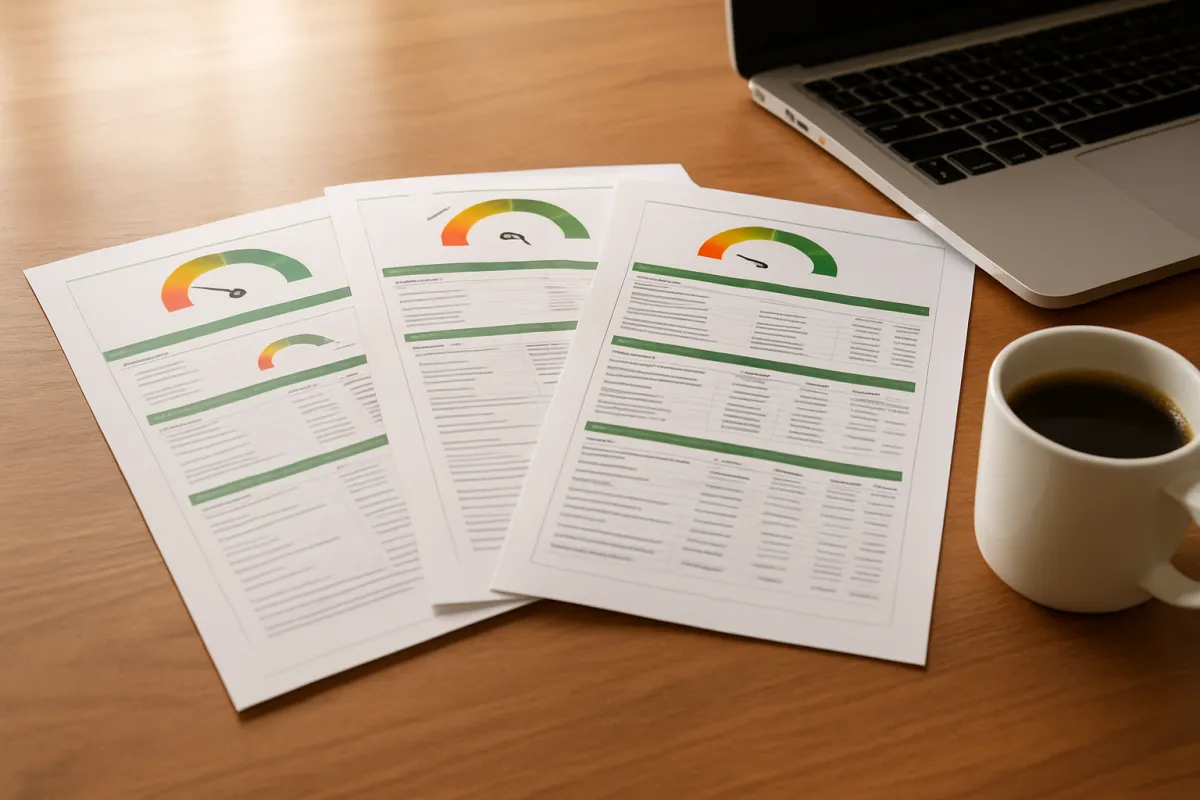
Now the third face of the question, the multi-score mystery. One app shows one number. Your bank shows a higher one. A card issuer shows a lower one. None of them is wrong and nothing has broken, because there is no single number called your credit score. There are three separate bureau files, many scoring models reading them, and a refresh calendar that differs site by site. Any two displays can differ on all three dimensions at once, and the visible gap is the sum of those differences rather than evidence of an error.
The spread unsettles people because it feels like a contradiction, and occasionally it is informative: a large, persistent gap between bureaus can mean one file carries something the others do not, which is worth investigating on the reports themselves. But a gap between sites running different models on different refresh dates is ordinary and expected. The productive habit is to pick one source and track its trend rather than comparing across sources. A score rising steadily on one consistent model is telling you the file is genuinely improving. Three numbers compared across three models on three dates are mostly telling you about the models.
Bureaus, models, and dates: the three sources of score gaps
The first source of gap is the bureau. Your credit history lives in three separate files at three separate companies, and lenders are not required to report to all of them. A card that reports to two bureaus leaves the third file lighter. A collection agency might report to only one. Small file differences produce score differences before any model is involved at all. The second source is the model. Scores are produced by competing formulas, in multiple generations and industry-specific flavors, and each weighs the same file its own way. One model may treat a high single-card balance harshly; another may treat a paid collection more kindly. The same file, run through two models, lands on two numbers.
The third source is the calendar. Each account reports once a month around its own statement date, each bureau applies updates as they arrive, and each site refreshes its display on its own schedule, weekly for some and monthly for others. A balance paid down early in the month may show on one site within days and on another only weeks later. Stack the three sources together and a visible spread across sites is not merely possible but expected. The gaps worth acting on are the ones inside a bureau: if one bureau’s file carries an account or a mark the others lack, that is a real difference in the underlying record, and reading all three reports side by side, per our report-reading playbook, is how you catch it.
Which credit score is the real one?
The honest answer is none of them, and all of them. There is no master score sitting in a vault while the others approximate it. Every score is a real output of a real model reading a real file, and lenders simply choose which one to buy. A mortgage lender commonly pulls from all three bureaus, often using older model generations specific to mortgage underwriting, and works from the middle of the three. A card issuer might buy a card-industry flavor from a single bureau. An auto lender may use something tuned for auto lending, which is part of why our note on the credit score you need for a car loan talks in ranges rather than thresholds. The free score in your app is typically an educational model, entirely real but possibly not the flavor any given lender uses.
What should you do with that? Stop hunting for the true number and use the visible one as an instrument. Educational scores read the same file as lender scores, so they rise and fall together, and a sustained climb on your app reliably signals a stronger file even when a lender’s model lands somewhere else. When a specific application matters, especially a mortgage, the useful preparation is not chasing a displayed number but cleaning the underlying file: low reported utilization, no disputes in flight, no surprises on any of the three reports.
For calibration on what the top of the range even means, our note on what a perfect credit score is makes the case that the practical target is the strong-file band rather than any exact figure, because every model rewards the same behaviors once you are past its thresholds.
How to find out exactly what dropped your score
Time to turn the diagnosis into a repeatable procedure. Step one: pull all three credit reports, which you can do at no cost through the federally mandated channel. Do not skip the two you check less often, since the cause may live on only one file. Step two: date the drop. Write down the day the number moved and count backwards using the timing chart, so you know whether you are hunting for something that happened last week or something that happened last spring. Step three: scan for the loud causes. Read the payment grid on every account for a new 30-day mark, then look for any new collection, charge-off, or public record. Either you find one within minutes or you rule the whole category out.
Step four: check the quiet causes. Compare each card’s reported balance against its limit and compute utilization per card and overall. Check each card’s current limit against what you believed it was. Count hard inquiries from the past year. Look at open dates and any recently closed accounts to see whether the average age shifted. Step five: check for what is missing, an old account that vanished, a loan that closed on payoff. Step six: check the display itself, meaning which bureau and which model your app is showing, in case reason 9 is the whole story. Step seven: if everything looks ordinary and the move was small, record it as drift and re-check next month. A file that survives all seven steps without producing a cause is usually a file that is fine.
How to turn a falling score around
Once the cause has a name, the repair plan mostly writes itself, because each cause has a known counter. Utilization damage reverses fastest: pay balances down before statement closing dates, spread balances so no single card reports high, and raise limits where you can, and the number typically recovers within one or two cycles as lower figures report. A partial balance transfer is one clean way to do that spreading, since it moves only the slice a promotional card will hold and trims interest at the same time. Inquiry damage needs nothing but months. Age damage from a new account heals as the account ages, and the best response is to stop adding more. Limit-cut damage responds to a restoration request, to shifting balances, or to deeper paydown.
Payment-history damage is the slow lane, and honesty matters here: a late payment or a collection cannot be quickly erased when it is accurate. The repair is a long unbroken run of on-time payments layered on top while the mark ages and its weight fades, plus goodwill requests for a one-off lapse against a strong history, plus disputes for anything genuinely inaccurate. Automate the floor so it cannot happen again, with autopay covering at least the minimum on every account and a larger manual payment on top when you can, the same architecture our payoff playbook recommends on cost grounds alone.
And when the balances themselves are the root problem, driving utilization and payment strain at once, the arithmetic of clearing them faster is the whole subject of our debt payoff calculator. Score repair and debt repair are usually the same project wearing two names.
When a score drop matters, and when to let it pass
Not every drop deserves a response, and knowing the difference saves both worry and mistakes. A drop matters when two things are true at once: it is large or persistent, and you have a credit decision coming. If you are applying for a mortgage in the next few months, a steep slide is urgent and worth diagnosing this week, because pricing tiers on large loans turn real money on score bands. If you have no application on the horizon, the identical slide is merely important, worth diagnosing and correcting on an ordinary timeline while the file heals on its own schedule.
A drop can be safely left alone when it is small, explained, and self-reversing: the dip after opening a planned new card, the wobble after paying off a loan, the drift from one heavy statement month, the gap between two apps running different models. These fade without intervention, and intervening tends to make them worse, since the instinctive responses of closing the new card or shuffling accounts are themselves negative moves. The steady posture is the one this playbook keeps returning to. Check the score often enough to know your baseline, read the reports a few times a year, respond to causes rather than to numbers, and reserve genuine urgency for late marks, collections, and signs of fraud, the events with long memories.
A worked example: one statement date, one avoidable drop
Put the whole diagnostic to work on one illustrative case. A borrower holds two cards, one with a $3,000 limit and one with a $5,000 limit, so $8,000 of total limits. In March she puts a $2,600 emergency car repair on the smaller card. She pays it in full by the April due date and never owes a cent of interest. But the statement closed before her payment landed, so the card reported $2,700 against its $3,000 limit: 90% used on that card, and about 34% across the $8,000 of total limits. Her score falls within weeks. Nothing was late and nothing was new. The snapshot simply caught the balance at its peak.
Now run the procedure. She dates the drop and counts backwards; the gap is about a month, which the timing chart points at statement balances or a limit cut rather than at anything from the payment-history family. The report scan confirms it: no late marks, no collections, no new inquiries, no closed accounts. The per-card utilization check finds the 90% card immediately, and the limits are unchanged, so utilization it is.
The repair is timing rather than money, since she already pays in full. The following month she pays the balance down before the statement closing date, the card reports under $300, and overall utilization lands under 4% of the same $8,000 in limits. Within two cycles the number is back near where it started. Change one detail, a payment that slipped 30 days late during the chaos of the repair, and the same story plays out over years instead of weeks. That contrast, between a fast-healing balance problem and a slow-healing history problem, is the most useful thing to carry away from this playbook.
The bottom line
Why is my credit score going down? Because something in the file changed, and the calendar tells you which something. An inquiry lands in days, a balance at the next statement close, a limit cut a few weeks after that, a late payment about two months after the missed due date, and a collection roughly half a year after the trouble began. Two more causes have no clock at all: an error, and a change in which score you are looking at.
Why is it not improving? Usually because statement-day balances or a young file are capping it while the on-time payments you are rightly proud of hold the floor rather than raise the ceiling. Why is it different on every app? Because three bureau files, many models, and mismatched refresh dates guarantee a spread. The thread running through all three questions is that the score is a shadow and the report is the object casting it. Date the drop, read the report, name the cause, apply the matching fix, and give the file the time it insists on. Scores fall in cliffs and recover in stairs, and the borrower who reads the file instead of guessing climbs them considerably faster.
A note on what this playbook can and cannot do: it explains, in general educational terms, how credit scores tend to behave, and none of it is financial, legal, or credit-repair advice for your particular file. Every percentage, dollar figure and timeline here is illustrative, chosen to show the shape of the mechanics rather than to predict your outcome, and no point values appear anywhere because the same event moves different files by different amounts. Reporting practices, dispute procedures and model behavior also change over time, so confirm current details with the bureaus or with your own lender. For decisions carrying real stakes, a mortgage, a dispute that has stalled, suspected identity theft, bring in a qualified professional, a nonprofit credit counselor, or an attorney rather than relying on any article, this one included.
Frequently asked questions
Why is my credit score going down even though I pay on time?
On-time payments protect the heaviest scoring factor, but they are only one factor. The quiet culprits are usually rising credit utilization, which is the share of your limits you are using on the day each statement closes, a shrinking average account age after opening or closing accounts, a burst of hard inquiries from applications, or a credit limit cut that raised your utilization without any new spending. A score can fall while every bill is paid perfectly because the other factors moved. Pull your reports, compare this month against last month, and the change is almost always sitting in one of those categories.
Why does my credit score go up and down every month?
Because the score is recalculated from scratch each time it is requested, and the file it reads changes every month by design. Each card reports its statement balance once per cycle, on its own closing date, so a heavy spending month reports a higher balance and a light one reports lower. With several cards closing on different days, the balances feeding the calculation are never the same twice. Add an inquiry that is still fading, an account that is aging, and refresh dates that differ by site, and monthly movement in both directions is the normal state of a healthy file rather than a warning sign.
Why is my credit score not improving?
Stuck scores usually mean the file is clean but thin, young, or consistently loaded. If you pay on time yet report high balances every month, utilization caps your progress no matter how responsible the spending is. If your oldest account is only a couple of years old, time itself is the missing ingredient and no technique substitutes for it. And if a past late payment or collection sits on the report, steady behavior helps gradually while the mark ages rather than instantly. Lowering what reports on statement day and letting accounts age are the two levers that unstick most files.
Why is my credit score different on different sites?
Because there is no single credit score. Different sites pull from different bureaus, and your three bureau files rarely match exactly, since lenders do not all report to all three. Sites also use different scoring models, and each model weighs the same file differently. Finally, scores refresh on different dates, so one site may already include a balance another has not seen yet. A visible gap between apps on the same morning is ordinary and is usually not evidence that anything is wrong with your credit.
Which credit score do lenders actually use?
It depends on the lender and the product, which is unsatisfying but honest. Many lenders use one of the widely known scoring families, often an industry-specific version tuned for cards, autos, or mortgages, and they may pull from one bureau or from all three. The free score in an app is typically an educational score that reads the same underlying file, so it moves in the same direction as lender scores even when the number differs. Treat your visible score as a compass rather than the exact figure a lender will see, and focus on the report behind it, which is what every model reads.
How do I find out exactly what made my credit score drop?
Work backward from the report, not from the score. Pull your credit reports from all three bureaus, which you can do at no cost through the federally mandated channel, and compare the current report against an older copy or against what you remember. Look for four things in order: any payment newly marked late, any new account or inquiry you do not recognize, balances that reported higher than usual, and any account that closed or had its limit reduced. Most score-drop mysteries dissolve within minutes of a line-by-line read. If something is genuinely wrong, dispute it with the bureau, because errors are correctable.
How fast can a falling credit score recover?
It depends entirely on the cause. Damage driven by utilization can reverse within one or two statement cycles once lower balances report, which makes it the fastest fixable kind. Damage from a hard inquiry fades over months without any action. Damage from a late payment or a collection recovers slowly, because the mark stays on the report for years while its weight gradually fades, and recovery there is measured in months of clean history rather than weeks. The working rule: balance-driven damage is quick to undo, history-driven damage is slow, and both respond to the same habit of paying on time and reporting low balances.
Can checking my own credit score make it go down?
No. Checking your own score or report is a soft inquiry, and soft inquiries are not visible to scoring models at all. The inquiries that can cost you are hard inquiries, which happen when a lender pulls your file because you applied for credit. Even those are among the mildest and fastest-fading negatives on a report. You can check your score every day without harm, and regular checking is the habit that catches real problems early, which is why the advice to check less often gets the mechanics backwards.

Hamza Hai is the editor of BorrowLane. She holds an MBA and reviews the site's articles against our editorial standards, checking that every figure is labelled for what it is, that nothing is presented as verified fact without a source the reader can check, and that the writing stays useful to a non-specialist.